
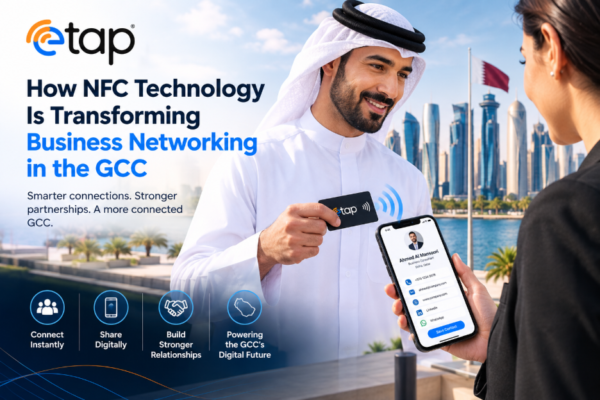

Business networking in the Gulf is becoming increasingly digital. Professionals who once exchanged paper business cards now routinely connect through LinkedIn, WhatsApp, QR codes, digital profiles and mobile devices.
The next step in this evolution is NFC.
Near Field Communication, or NFC, allows compatible devices to exchange information when brought close together. While most people associate NFC with contactless payments, the technology has applications across business networking, hospitality, retail, events and customer engagement.
For the GCC, this development is particularly relevant. Digital transformation is already reshaping how companies communicate with customers and partners, creating an environment where contactless interactions feel natural.
Why the GCC Is Ready for NFC Networking
The Gulf has become one of the world’s most digitally connected business regions. Saudi Arabia, the UAE and Qatar are investing heavily in digital infrastructure, smart services and cashless experiences.
Saudi Arabia provides a useful indicator of the broader transformation. The Saudi Central Bank reported that electronic payments accounted for 85% of total retail payments in 2025, up from 79% in 2024, with electronic transactions reaching 14.6 billion.
This does not mean that NFC business cards are replacing every traditional networking method. Instead, it demonstrates something more fundamental: consumers and professionals are increasingly comfortable interacting with technology through simple digital experiences.
That makes the concept behind an NFC business card straightforward:
Tap → Open digital profile → Connect.
There is no need to type a phone number manually or search for a person’s company online.
What Is an NFC Business Card?
An NFC business card is a physical card containing a small NFC chip.
The chip can be programmed to direct a smartphone to a digital profile. That profile might contain:
- Name and job title
- Company information
- Phone number
- Email address
- Website
- LinkedIn profile
- Social media
- Portfolio
- Location
- Appointment links
- Product information
The physical card becomes the starting point, while the digital profile contains the information.
This distinction is important because it makes the card more flexible than a conventional printed business card.
If a professional changes their phone number, job title or website, the digital profile can be updated without printing a new batch of cards.
NFC and the Modern Networking Event
Consider a typical GCC business conference.
Hundreds of attendees may exchange cards over two or three days. Traditional networking creates a familiar problem: people return to their offices with pockets full of cards but little context about who they met.
An NFC card can make the interaction more memorable.
A professional can tap their card against another person’s smartphone. Their digital profile opens immediately, allowing the recipient to save contact details or continue the conversation through WhatsApp, LinkedIn or email.
For event organizers, NFC can also extend beyond business cards.
NFC technology can support:
- Event check-in
- Digital exhibitor profiles
- Product information
- Booth engagement
- Feedback forms
- Lead-generation pages
- Digital brochures
The physical interaction remains simple while the information behind it becomes much richer.
Hospitality Is Another Major Opportunity
Hotels, restaurants and tourism businesses can use NFC to connect physical spaces with digital services.
A hotel could place NFC touchpoints near reception, elevators or guest areas to provide information about facilities, restaurants, transportation or concierge services.
A restaurant could use NFC stands to connect customers with menus, loyalty programmes or review pages.
This type of implementation is particularly relevant in the Gulf, where hospitality plays a significant role in the regional economy.
The technology is not valuable because it is complicated. It is valuable precisely because it can simplify an interaction.
Reducing Dependence on Printed Information
There is also a sustainability argument for digital networking.
Qatar National Vision 2030 includes environmental development as one of its four interconnected pillars and calls for development that balances economic and environmental considerations.
Replacing every printed business card with an NFC card will not solve a company’s sustainability challenges. However, reducing repeated printing of outdated contact information is a practical step toward a more digital workflow.
A professional who changes companies, roles or contact details can update their digital profile rather than discarding hundreds of printed cards.
For companies with large sales teams, this difference can become meaningful over time.
NFC Is More Than a Business Card
The most interesting future for NFC in the GCC is likely to be broader than networking.
Businesses can connect NFC touchpoints to specific digital actions.
For example:
Restaurant: Tap → Review page
Hotel: Tap → Guest services
Retail store: Tap → Product information
Real estate agent: Tap → Property portfolio
Consultant: Tap → Appointment booking
Conference: Tap → Digital profile
Corporate office: Tap → Smart-access experience
The same fundamental technology can support completely different business objectives.
The Future of Business Networking in the Gulf
The GCC is moving toward a business environment where digital experiences are increasingly expected to be immediate.
Professionals do not necessarily want another complicated application. They want simple tools that work when they need them.
That is where NFC has an advantage.
A physical card still provides the familiarity of traditional networking, while the digital layer provides flexibility, richer information and measurable engagement.
Companies such as etap NFC Solutions are helping businesses in Qatar adopt this approach through NFC digital business cards and other contactless solutions designed for professional and commercial use.
The future of networking in the GCC may not be completely digital or completely physical.
It may be both.
A physical interaction can create the connection, while a digital experience can build the relationship.
And that is exactly where NFC fits.


